Thursday, July 4, 2013

Our Declaration of Dependence - 4th of July as seen through Luke 10.1-9


Gospel Passage 
Luke 10.1-9 
 
DECLARATION OF DEPENDENCE

What a way to begin Independence Day. “I am sending you like lambs among wolves. Carry no money bag, no sack, no sandals. Eat what is placed before you.” What? So much for Good News! 

And these words of Jesus are especially bothersome today for they come to us on Independence Day!  Yet these words imply a radical dependence! A total reliance on God and one another, for he sends the disciples out two by two.

But I ask are we really independent or do we recognize our dependence upon God? Are we Americans first, then followers of the Gospel? Which messengers are we following? FOX News, CNN, MSNBC, the National Enquirer or Cosmopolitan – or Matthew, Mark, Luke, or John?

The world says that the more we have, then the better off we are! The world says to consume and use whatever we can to make a name for ourselves. If I can just get that new car or a bigger house or whatever it is, then I’ll be somebody! 

Advertisers spend billions of dollars every year telling us that we need their products to make us acceptable and help us achieve more! Right? Isn’t that right?

But Jesus tells us today to live simply and not be weighed down with all that extra stuff and not allow our possessions to possess us!  So maybe that’s the whole point of the gospel message – that we have become so independent-minded, that we are actually too dependent upon the wrong things and not dependent enough on God.

Christ commands us to live radically simple lives, relying less on things, and relying more on Him and one another; not asserting so much our independence as our interdependence upon one another. 

This means that we cannot live just as Americans or citizens of the U.S., though that we are, but our worldview must be focused on the Cross of Christ! Christ’s worldview turns the world’s view upside down. 
So I ask are we Catholics first, then Americans, or have we allowed American values to dictate what parts of the gospel we like and discard what doesn’t seem to fit our political agenda?
Christ calls all people to himself. And so has the United States in her history.

Can we imagine what it would be to leave everything we know, leaving our native land and immigrating here with a different language? The people that made the journey to the United States often had little more than a dream in their heart and a hole in their pocket. Many were literally penniless, having sold all they had to simply purchase the ticket to sail on the boat, and with no real guarantee they would be granted entry or survive in the New World. 

And these exiles, arriving here tattered and torn, with a few words of English, set out to begin a new life. Many of these exiles had nothing to speak of, no money bag, no extra pair of shoes, but only the clothes on their backs. And for many the first sight they beheld upon arriving here was the Statue of Liberty.

The image that comes to mind for many of us on this Independence Day weekend is the Statue of Liberty, a universal symbol of freedom and democracy.


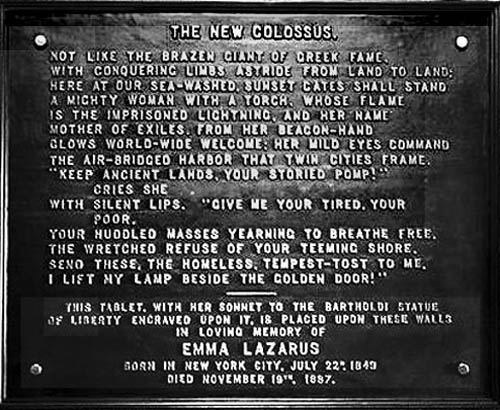
The bronze plaque on the Statue of Liberty’s giant pedestal calls her the Mother of Exiles, from the poem by Emma Lazarus.

How many souls long to belong, long for welcome in this world of ours, and imagine all those who journeyed here to the U.S., whose first sight was the Mother of Exiles, Lady Liberty.
The plaque reads: “Give me your tired, your poor, Your huddled masses yearning to breathe free!

Interestingly, the name "Mother of Exiles" was never taken up as the Statue of Liberty’s name, even though it is engraved in bronze. Yet as Catholics our Blessed Mother and Mother Church herself have both been called “Mother of Exiles”. And isn’t this the hope of all exiles, that they will find welcome and rest and a home? 

 Yet in a way, as Catholics, we are exiles in this world. If we live by gospel values, we may well be exiled by our neighbors or even our friends. Some may say of us that we’ve gone too far with our faith in this Jesus business, that we are unpatriotic to the point where we place gospel values above American values. 

It is certainly an interesting thought to imagine that the Statue of Liberty is calling us to be better Americans and in the process better Christian, better Catholics.

So if we are marked by the sign of the cross, then we can expect suffering, rejections, and crucifixion. Not everyone can or will accept the gospel cross. We will be judged as fools for Christ.  We will be going against the popular opinion.  Yet we recognize that Only in God is our soul at rest; our true fulfillment will not be in any party, except the party of Christ. Our independence day is celebrated on Good Friday. St. Paul encourages us to find our freedom in the cross of Christ.

Finding rest in Christ, recognizing His Mother as our Mother, and knowing that the Church herself is the Mother of Exiles, is truly liberating! The irony of today is that our true independence is found in our dependence upon God, Christ, 
Mary, the Church, indeed our dependence upon one another.


There is no such thing as a lone Christian. We are in this together.  And just as Jesus instructed his disciples, he continues to instruct us that we must trust in God for our defense and depend upon the hospitality of others for our well being. And this is what we celebrate today: our Dependence upon God and dependence upon one another. God alone is enough.    

But if God alone is too much for our neighbors or family to handle, if believing in Christ and following the gospel somehow makes us less patriotic than other Americans, then let us repeat the words of Patrick Henry: “If this be treason, let us make the most of it!” 


Wednesday, July 3, 2013

Lord, do you want us to call down fire from heaven to consume them?


Thirteenth Sunday in Ordinary Time Year C 2013 St. Mary’s Church / St. John’s Church Evansville, Indiana 30 June 2013

The reading for the day were Galatians 5.1, 13-18 and  Luke 9.51-56

  
Did I just hear what I read?? Seriously. A particular Samaritan village did not welcome Jesus and his disciples, James and John, ask: “Lord, do you want us to call down fire from heaven to consume them?” Burn them up. Destroy them. Consume them?
These are the Disciples of Christ. But they make this horrific request. To kill other human beings. 

This gospel should disturb us. 

Jesus turned and rebuked his disciples for making such a request! His disciples had gotten so off track of the message of the kingdom of God that he had to rebuke them for wanting to kill some Samaritans simply because they were lacking in hospitality.

But why did the Samaritans refuse to welcome Jesus and his company? It may have been due to previous negative experiences with other Jewish pilgrims who passed through their village. Perhaps it was because James and John were not very kind to them. We do not know. But for whatever reason, Jesus and his band of followers were not welcome.

Interestingly enough, in all of the gospels, there are no Samaritans that call for Jesus’ death. Many Samaritans DID accept Jesus. Recall the Samaritan Woman? What of Jesus’ parable of the Good Samaritan?

Yet the disciples in Luke’s gospel have become rather possessive of Jesus, possessive of the kingdom, and very judgmental in their view of who could be worthy of the kingdom of God or even share in the ministry of Christ.

Oh, we can you hear the pride, the self-importance, the arrogance; the elitism.  But the kingdom of God is not a country club for the spiritually or ethnically or nationally elite.


In our own day we are bombarded and consumed daily by those who seek justice for themselves against others. For others their call for justice is often a hidden desire for revenge. Others openly admit that they do not want justice, but revenge. Some even pray that God should destroy others.

But who are we to judge others as unworthy of God’s love?  Who are the Samaritans in our midst that we judge as unworthy of Christ’s love and our love?   

Oh, we may not say it that way, but our demeanor towards certain others speaks volumes.

What about the man who is hungering for love each week as he makes it up the steps of our church, but is often ignored because he is not one of the beautiful people? What about the chronically depressed…the unemployed or the underemployed… What of the teenagers or young adults or the aged who are just waiting to be asked to do something in the name of Christ?

How do we look at others? Or talk about others?  And though we may not ask the Lord to “nuke” others out of existence, how easily do we sometimes render others invisible?  Personae non gratae?

I’ve had people tell me that they feel invisible in many of our parishes – “people see right through me” they say. No one welcomed me to church. No one missed me when I stopped coming to Mass. No one called to check on us. But they did call when they wanted money. Real or imagined, these are genuine hurts.

Many people are consumed with great anxiety and distress. The hurting needing the salve of kindness, the sorrowful looking to be consoled, the doubtful looking for faith, the hungry craving for belonging, the unwelcome longing for an invite to dinner, those thirsting for companionship, the poor seeking comfort –
all of these we can likely find right here in our midst, in these very pews, today – they are not just “out there” in some nebulous mass of humanity.

We touch one another here in a unique way; and we have the opportunity to change other people’s lives for the better through our daily prayer and through our daily acts of charity.
So who are the Samaritans God is calling us to embrace?
You know “Love your neighbor as you love yourself” is not just a nice Christian catchphrase!

Social justice must begin here before we go out there!
Any time then when we fail to recognize the dignity of each human person, we run the risk of being tempted to call down fire from heaven to consume them.

But we cannot live according to the flesh, as St. Paul reminds us. It’s not about our designer clothes, our social status, our shiny cars, sumptuous homes, or even our well-tanned flesh or sleek, slender, sexy well-toned bodies.

Have we become too comfortable, too consumed with ourselves?

We are called to live by the Spirit in freedom. And our freedom is for love. And it must begin here. In these pews. In these aisles. In the foyer. In the parish hall. And especially in the parking lot.
No one who recognizes his neighbor as a fellow member of the body of Christ – or even a potential member of the Body of Christ – would ever seek to harm another person. Instead we will only desire others’ welfare and holiness and health. We will not seek to back-bite or devour one another - not even our enemies.

The good news about James and John is that they who wanted fire to consume their enemies were eventually consumed with the mercy and love of Christ.

James (James 2.13) writes: “For since we are in the freedom of Christ, ‘Judgment is merciless to the one who has not shown mercy; for mercy triumphs over judgment!’”

St. John also wrote extensively: (1 John 3:16) “Let us love one another, for love is of God..” “Everyone who hates his neighbor is a murderer….” (1 john 4 .11) …”and If God so loved us, we also must love one another.

All of us have the freedom to love and forgive. And when we truly surrender to this freedom, and exercise this freedom, we will make it is easier for others to experience their freedom, blessedness and human dignity.

And then once we catch fire with Christ’s passion we won’t want to consume others with our prejudice; and we won’t have time to make excuses for delaying our response to Christ and our neighbor; but we will cast caution to the wind and freely take up our cross, allowing ourselves to be consumed in the fire of God’s love, burning bright, set free to love, to heal, and to secure justice for all the oppressed.

Monday, June 3, 2013

THE SOLEMNITY OF THE MOST HOLY BODY AND BLOOD OF OUR LORD JESUS CHRIST


Jesus is not safe. And he doesn't want us to stay safe
Following Christ is dangerous business. 
He wants us to die to ourselves and share our lives!
All Eucharistic celebration – and adoration – must lead to service.


In today’s Gospel the disciples are genuinely concerned for the 5000 men – not including women and children – who are likely very hungry and in the middle of nowhere. The disciples want Jesus to dismiss the crowds so they can go to the nearest village and buy food, but Jesus insists “Give them food yourselves.”  Really? They are in the middle of nowhere. It’s as if Jesus had intentionally gathered together people from all walks of life and then led them out into this wilderness.

In John’s account it is Andrew who brings a young boy to Jesus who is willing to share his five barely barley loaves and two skinny scrawny sardines, but what good are these for so many? But never let anyone ridicule you for your five loaves and two fish. It is enough.

Jesus immediately tells the disciples to have the people sit down in groups of fifty. Groups of fifty. Sounds like he was encouraging community.

Then Jesus miraculously multiplies the loaves and fish to provide a veritable banquet for the people out of seemingly nothing – and in the middle of nowhere. Five loaves and two fish? Really? Yes, the Lord can take our small offering and multiply it beyond our imaginings. Never let anyone ridicule you for your five loaves and two fish. It is enough. The Lord will provide good and plenty.
                                                                                                                                                                       
This wonderful feast day gives us an opportunity to ponder the gift of the Eucharist. This sacrificial meal of thanksgiving is THE Sacrifice which sums up all of the sacrifices ever offered. And in Jesus’ one act, He restores us to right relationship with God, and be the Prince of Peace and bring us peace.

Jesus is the king of Israel as he gathers His people and then feeds them, tends them as a shepherd. Can we imagine the table fellowship! Jesus welcomes all! He literally goes out to the hedgerows and the margins of society to feed us! This is Christ the King feeding the gathered people. We commune with the priest-king and enter into sacrifice together with each other.

The Eucharist is what makes the Church the Church. The Church comes from the Eucharist. We long for the bread of life. We long for the wine of compassion. We all long for inclusion, for belonging, for unity, for meaning, for love.

It is right and just to give God thanks and praise ; by Participating in the Mass, we too offer our five barely barley loaves and two skinny scrawny sardine fish upon the paten, but Christ will multiply our meager offering beyond our imaginings.

Christ offers us the bread and wine that is his very body and true blood, our food for the journey that lay ahead for each of us: in this life and beyond. Christ is ever present. We see and experience Christ in the Eucharist. And when we break this bread and share this cup, we commune with each other as well as with those here on earth, those in Purgatory, and those in Heaven.                

There can be a tendency for some people to want a very clean and tidy Catholic, Christian faith where it is just me and Jesus in a nice adoration chapel with Jesus safe within the tabernacle or monstrance.

But Jesus is not safe. And he doesn't want us to stay safe. Following Christ is dangerous business. He wants us to die to ourselves and share our lives! In fact, as we go out of our way, we may well suffer, and our own body might become bloody, and thereby resemble that of our Lord Jesus. Discipleship is a fearful thing.

Please do not misunderstand me: prayer before Jesus in the Blessed Sacrament is incredibly powerful; I am fortunate to have grown up with this practice. Many days after work I would walk or ride my bike to kneel in the silence before Jesus; in college many nights from 11 to 12 I kept vigil with Christ for an hour; then when my wife and I were dating we went to daily Mass and after we were married every Monday night from 7-8 pm we kept vigil with Jesus at a local adoration chapel; later when the children were young I took the 11-12 pm hour at our parish. And still now here I continue to spend time with Christ, but it can never end there. Prayer must change us.

Prayer cannot end at the tabernacle! Christ sends us out from prayer to seek our lonely neighbor, to visit those in hospital or nursing home, to reconcile with our estranged children or relatives, to feed the hungry, to comfort the sorrowful, to clothe the naked, welcome the immigrant, and visit the imprisoned.  

  
Mother Teresa's Sisters spend an hour in adoration of the Eucharist BEFORE they spend the rest of the day walking among the poorest of the poor, seeing Christ and serving Christ in the least of these.


All Eucharistic celebration – and adoration – MUST lead to service. Jesus IS present in the Eucharist – but we must see and love Christ in the stranger, in the poor, in the least among us – and yes, even in our own family members.

So whether it is volunteering with the Vincent de Paul, or working a Soup Kitchen, tutoring a child, helping a neighbor, visiting a lonely widow –  or loving your spouse or child when he or she is not particularly loveable, the Eucharist is about dying to self and rising to new life.


Pope Francis has been continually telling us through his living public witness that we must go out of our way, out of ourselves, willing to leave our self-contained, secure worlds, to venture to the margins of society, to that other part of town, in order to bring Christ to others just as Jesus went out to the crowds. The Eucharist and the Holy Spirit will give us the strength to do this. – Only then will we truly become the Body of Christ.

Yes the Holy Eucharist – the Body and Blood of Christ – is that which brings us together, and, in fact, the Eucharist forms us as The People of God. We are nourished from this altar.

And after receiving the bread of life and the chalice of salvation, we pray that we may truly become the very body and blood of Christ to the World, bringing salvation to all those around us; and may each of us pray as did Saint Paul, “It is no longer I who live, but Christ Jesus who lives in me.”