Showing posts with label immigrants. Show all posts

Thursday, July 4, 2013

Our Declaration of Dependence - 4th of July as seen through Luke 10.1-9


Gospel Passage 
Luke 10.1-9 
 
DECLARATION OF DEPENDENCE

What a way to begin Independence Day. “I am sending you like lambs among wolves. Carry no money bag, no sack, no sandals. Eat what is placed before you.” What? So much for Good News! 

And these words of Jesus are especially bothersome today for they come to us on Independence Day!  Yet these words imply a radical dependence! A total reliance on God and one another, for he sends the disciples out two by two.

But I ask are we really independent or do we recognize our dependence upon God? Are we Americans first, then followers of the Gospel? Which messengers are we following? FOX News, CNN, MSNBC, the National Enquirer or Cosmopolitan – or Matthew, Mark, Luke, or John?

The world says that the more we have, then the better off we are! The world says to consume and use whatever we can to make a name for ourselves. If I can just get that new car or a bigger house or whatever it is, then I’ll be somebody! 

Advertisers spend billions of dollars every year telling us that we need their products to make us acceptable and help us achieve more! Right? Isn’t that right?

But Jesus tells us today to live simply and not be weighed down with all that extra stuff and not allow our possessions to possess us!  So maybe that’s the whole point of the gospel message – that we have become so independent-minded, that we are actually too dependent upon the wrong things and not dependent enough on God.

Christ commands us to live radically simple lives, relying less on things, and relying more on Him and one another; not asserting so much our independence as our interdependence upon one another. 

This means that we cannot live just as Americans or citizens of the U.S., though that we are, but our worldview must be focused on the Cross of Christ! Christ’s worldview turns the world’s view upside down. 
So I ask are we Catholics first, then Americans, or have we allowed American values to dictate what parts of the gospel we like and discard what doesn’t seem to fit our political agenda?
Christ calls all people to himself. And so has the United States in her history.

Can we imagine what it would be to leave everything we know, leaving our native land and immigrating here with a different language? The people that made the journey to the United States often had little more than a dream in their heart and a hole in their pocket. Many were literally penniless, having sold all they had to simply purchase the ticket to sail on the boat, and with no real guarantee they would be granted entry or survive in the New World. 

And these exiles, arriving here tattered and torn, with a few words of English, set out to begin a new life. Many of these exiles had nothing to speak of, no money bag, no extra pair of shoes, but only the clothes on their backs. And for many the first sight they beheld upon arriving here was the Statue of Liberty.

The image that comes to mind for many of us on this Independence Day weekend is the Statue of Liberty, a universal symbol of freedom and democracy.


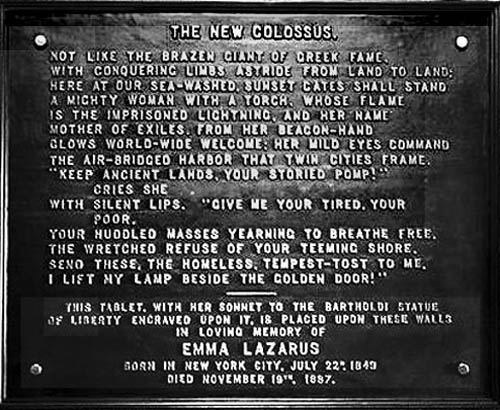
The bronze plaque on the Statue of Liberty’s giant pedestal calls her the Mother of Exiles, from the poem by Emma Lazarus.

How many souls long to belong, long for welcome in this world of ours, and imagine all those who journeyed here to the U.S., whose first sight was the Mother of Exiles, Lady Liberty.
The plaque reads: “Give me your tired, your poor, Your huddled masses yearning to breathe free!

Interestingly, the name "Mother of Exiles" was never taken up as the Statue of Liberty’s name, even though it is engraved in bronze. Yet as Catholics our Blessed Mother and Mother Church herself have both been called “Mother of Exiles”. And isn’t this the hope of all exiles, that they will find welcome and rest and a home? 

 Yet in a way, as Catholics, we are exiles in this world. If we live by gospel values, we may well be exiled by our neighbors or even our friends. Some may say of us that we’ve gone too far with our faith in this Jesus business, that we are unpatriotic to the point where we place gospel values above American values. 

It is certainly an interesting thought to imagine that the Statue of Liberty is calling us to be better Americans and in the process better Christian, better Catholics.

So if we are marked by the sign of the cross, then we can expect suffering, rejections, and crucifixion. Not everyone can or will accept the gospel cross. We will be judged as fools for Christ.  We will be going against the popular opinion.  Yet we recognize that Only in God is our soul at rest; our true fulfillment will not be in any party, except the party of Christ. Our independence day is celebrated on Good Friday. St. Paul encourages us to find our freedom in the cross of Christ.

Finding rest in Christ, recognizing His Mother as our Mother, and knowing that the Church herself is the Mother of Exiles, is truly liberating! The irony of today is that our true independence is found in our dependence upon God, Christ, 
Mary, the Church, indeed our dependence upon one another.


There is no such thing as a lone Christian. We are in this together.  And just as Jesus instructed his disciples, he continues to instruct us that we must trust in God for our defense and depend upon the hospitality of others for our well being. And this is what we celebrate today: our Dependence upon God and dependence upon one another. God alone is enough.    

But if God alone is too much for our neighbors or family to handle, if believing in Christ and following the gospel somehow makes us less patriotic than other Americans, then let us repeat the words of Patrick Henry: “If this be treason, let us make the most of it!” 

Monday, June 11, 2012

THE MUSTARD SEED - AN UNLIKELY KINGDOM


1) When I was a little boy growing up in Vincennes, my father took me past his boyhood home and showed me a large Walnut tree. This tree was special to him because when he was but a small boy in the 1940s, his father helped him plant the walnut seed. My dad was amazed that the seed sprouted and the tree grew. It is still there and is very large! On this father’s day, my dad’s tree is a testament to his faith that that small walnut would grow. He is still amazed that the tree grew from the walnut and that it has withstood the test of time.

In the bible, the Cedar tree is extolled as a symbol of the majesty of God. The cedar tree grows upwards to 130 feet tall with a trunk of more than 8 ft in diameter. The Cedar trees of Israel and Lebanon were used for building ships, palaces, and temples. King Solomon built the great Temple in Jerusalem with cedar trees. And the Psalmist reminds us that: The just person shall flourish like a cedar of Lebanon.   

2)      Yet even though the scripture says that the great cedar tree will be lifted high, the prophet Ezekiel warns that the Lord will bring low the high tree and lift high the lowly tree.  And, again, the prophet Isaiah used the Lebanon Cedar as a metaphor for the pride of the world, as an arrogant example of worldly power and self-aggrandizement.

This is very similar to the Gospel message where Mary, the mother of Jesus proclaimed in her Magnificat: “He has cast down the arrogant of mind and heart; has thrown down the mighty from their thrones and has lifted up the lowly.”

3)      Jesus listeners were likely taken aback when he proclaimed that “the Kingdom of God is like a mustard seed.” A mustard seed? The smallest of seeds? Jesus’ followers were likely waiting for him to declare that the Kingdom of God is like a mighty cedar tree!

But no. Jesus confounds his audience and maintains that the kingdom of God is like the wild mustard plants that can grow into large shrubs and small trees. WHAT?  The Mustard plant is a weed in contrast to the impressive mighty cedar tree!  While the wild mustard takes over the field, we want order; but the weeds thrive and the mustard blooms and the birds of the air come to roost.

4)      Mustard does not need any cultivating, for it sprouts all by itself, for once a mustard seed falls in fertile soil, it germinates almost at once and begins growing. Mustard plants are not trees per se, but are bushes though they grow between 10 and 20 feet tall. And there are few plants which grow so large in one season as a mustard.

There is a definite "subversive and scandalous" element to this parable, in that the fast-growing nature of the mustard plant makes it an "undesirable, unwelcome weed" that will present a danger to the status quo or “business as usual.” Once a mustard seed is sown it is nearly impossible to get rid of.

5)      Jesus chooses the humble mustard seed over the image of a mighty cedar tree to show that even though the beginnings of the Kingdom of God are small, over time it would grow into something large and firmly rooted, in which many would find shelter and comfort, while others would find it detestable and even against tradition or respectable religion.

The growth of the kingdom is slow and rooted in a tiny beginning, but it is on the move.  Look at the growth of the early church, from a small following in the first century to the 3rd century where the mighty Roman Empire could not contain the rapid growth no matter how many Christians it put to death.

Or consider the days of slavery or the days of open discrimination and Jim Crow laws and segregation. Slowly but surely the march towards freedom took place. For instance, even though many Christians despised Martin Luther King and the civil rights movement, the movement refused to go away because the mustard seed of the kingdom and the gospel message had taken root in people’s hearts!

The wild mustard weed is nearly impossible to get rid of once it has infested a field, but so is the faith of those who seem to be weeds in the kingdom of God. And not only is this nasty weed unwelcome, but then so are the many different birds it attracts!

The wild mustard takes over the field, thriving like the kingdom, and the mustard blooms and the birds of the air come to nest! Just like all the "sinners" and tax collectors and the lowly ones who came to Jesus, these birds then threaten the well planted crop.

So the kingdom of God, like the mustard seed, poses a healthy challenge to the society and religion and to the hearer of the gospel: The church is not to be country club for self-righteous saints, it is an open field for the unwanted weeds and unwelcome birds.

The kingdom of God is messy. Worldly power is threatened by the Kingdom of God just as mustard seed threatens the perfect garden. We as subversive mustard seeds are called to challenge our culture, our society, and even members of our church. We, like the mustard plant, are called to invite the undesirable, unwelcome birds that seek refuge among us.

Yes, when we do this, we may well be viewed with suspicion, and be a thorn in the side of those who want to maintain the status quo, but the kingdom of God is not about “business as usual” in a perfect “weedless” garden.  

What the world considers a weed is really the greatest image of the kingdom of God.

No matter how small we consider our efforts or our faith, it is the beginning of great growth.  When we love our enemy and pray for him or her and when we walk with those who have lost faith, the mustard seed blooms! When we help a neighbor, visit the sick, or pay someone’s bills, the mustard seed blooms! When we make a meal for the lonely or those who are grieving the death of a loved one, the mustard seed blooms!

When we defend the human dignity of each and every person, regardless of nationality or language, the mustard seed blooms! When we stand up for those in poverty who have no voice, when we defend the rights of workers, the mustard seed blooms! 

When we assist the woman with an unplanned pregnancy–both before birth and after she gives birth, when we truly defend marriage by living our vows and giving witness to the sacrificial love that is marriage, when we love our children and our parents, no matter what they’ve done, the mustard seed blooms! For in the smallest acts of love the seeds of the kingdom bloom.

Let’s pray that our hearts might be like fertile soil ready to allow the seed of the kingdom to take root and germinate at once!

God’s love is constant. 

God is on the move. 

God’s kingdom moves forward.

The smallest seed of faith can grow into a great faith.

Even a giant walnut tree begins as a single walnut.

Wednesday, October 12, 2011

The Huckleberries in our Midst October 23, 2011


He looked like Huckleberry Hound, to be honest.  He was an unshaven character and his five o’clock shadow looked well past midnight, the loose skin of his jaws drooping and dangling. His clothes were shabby, shoes well-worn on the heels and in the toes; he always wore a ratty sports coat; in the winter his wraps made him look like a character from a Charles Dicken’s novel; and he had an unusual smell of mold.
I also knew this man from Church. He was a faithful mass-goer. In fact, he went to daily mass. As a young boy we began each school day with Mass and I had seen him for years at church. He would come into church, bless himself with the holy water, make his way down the aisle, genuflect, kneel and lean forward on the pew as if he was crawling into his heavenly Father’s lap and hugging him around the neck. His faith was visible. And when he came forward for communion, he always received communion on the tongue and returned to his pew and devoutly prayed, the intensity of his thanksgiving obvious. This man seemed to live his life as an alien among his fellow man.

He was also a regular customer at the Pancake Palace. He drove an old blue two-door 1967 Chrysler that was rusty along the fenders and underside; the tires were underinflated and the left turn signal was always on, eternally stuck and it blinked red wherever he went, even if he was going straight or turning right. You could see him coming down the street, he leaned to the left in his driver’s seat and he never broke 20 miles per hour; traffic behind him was bumper to bumper as he cruised into the Pancake Palace parking lot. With his eternal left turn signal on, it was a good thing he always turned left into the parking lot. He’d creep through the parking lot and usually park in the last parking slot on the south side of the building.
He smoked a cigar most of the time when he came into the restaurant. He always sat on the last stool at the counter. He ordered decaf coffee and then usually ordered the blue plate special of the day. He didn’t bother anyone and made no nuisance.  However, I never knew his name. We just called him Huckleberry Hound. He would speak to me as I was sweeping the floor or cleaning a table or washing the windows, and let me know I was doing a good job, but that was about it. That and his usual nod with the words, “God bless.”

In today’s first reading from Exodus, God is clear that we “shall not molest or oppress an alien, for you were once aliens yourselves in the land of Egypt…. You shall not wrong any widow or orphan. If ever you do wrong them and they cry out to me, I will surely hear their cries.” I know there are times when I just feel like this world is such an alien place and not my true home. And I know that still, today, we are all aliens here, for our true homeland is in heaven.
But aside from spiritual alienation, many of our ancestors were aliens in the U.S., weren’t they? Mine were. We can think of the tens of thousands of Irish, German, Italian immigrants who came here in the 1840s through the 1900s. America would not be such a great nation if they had been rejected or turned away then.

So whatever became of Huckleberry Hound? Well, it turns out that he was the son of German immigrants who had come to the states in the late 1800s. But he was very eccentric and chose to live very simply, perhaps so affected by the depression era that he lived with a very conservative view of money and the like. He certainly did not put on airs — or deodorant.
What we do know is that when he died at the age of 90 in the late 1980s, much to the surprise of many in town, he was identified as an entrepreneur of the prominent business and it was revealed that he was a millionaire. He was a widower and had no children. In his will he left a lot of money to charitable organizations and he left at large sum of money to the Church.

I was an altar server when he died. I recall his funeral. There were very few people who came. But I was glad I was there. And I have never forgotten him or what he taught me: never judge by appearances.
This man was the face of God obscured by his unshaven face and smelly coat. Yet he was an alien in our midst, a man with a story that was unfortunately never heard—at least until now. He died alone and was buried in the shadows of the cemetery, although he was a faithful Catholic who no doubt had heard the gospel and tried to live it in the best way he could everyday of his life.

I never heard him judge another human being; he loved God with his whole heart and soul, and his final act of gifting the church was so that others might know the love of God that he had known.
And even though others may not have loved him, let alone even known him, he was loved by God.

And so are you.

May we learn to give as generously as did this little man who looked like Huckleberry Hound.