Showing posts with label mercy. Show all posts

Monday, August 21, 2017

A loved one of so many tears will not be forgotten-as long as we are at the feet of Jesus.

20th Sunday Ordinary Time Year A     20 August 2017    

Deacon John William McMullen
Lord, help me. 

Gospel: Matthew 15.21-28

Jesus continues to go head to head with the religious authorities, the scribes and Pharisees, who are insistent upon telling Jesus how he has got to focus on who’s in and who’s out, who’s clean and who’s unclean in God’s eyes.  So many voices shouting him down when He calls for mercy and love.
So Jesus took his disciples on a retreat of sorts, a pilgrimage to a location where he could get away from all the arguing. (No Twitter or Facebook and no 24 hour news cycle).
He leaves Jerusalem and goes north, through Samaria and Galilee and continues north. He leaves the comfort of his home in Galilee, and crosses over the border into the territory of Tyre and Sidon! Greek Syro-Phoenicia.
Jesus is not safe. He’s on the move.
The disciples did not want Jesus going into the wrong neighborhoods or, God forbid, crossing any borders.
And that’s when she showed up - A Canaanite woman of that district came and called out, "Have pity on me, Lord, Son of David! My daughter is tormented by a demon."

A Canaanite woman? The Canaanites were the bane of Israel’s existence!

But, wait. In Matthew’s gospel, Jesus’ own genealogy mentions several Canaanite women. One was Ruth. She married the Hebrew man Boaz. She then became the mother of Jesse, and Jesse was the father of King David. So king David’s grandmother was a Canaanite woman!  Ah ha.

The woman says, “Have mercy on ME, but the concern is for her daughter who is tormented by a demon.” How many mothers have children who are tormented by various demons?
Where is Jesus in her desperation? He is silent. This does not mean he doesn’t hear her. He just doesn’t speak. He doesn’t act. Not yet at least.
* The disciples are annoyed by this woman’s prayer. “She’s bothering us! Send her away! Dismiss her! She’s too loud! Just give her what she wants to shut her up, then send her away! Was it because she was a Canaanite woman? Racism? Sexism?
Jesus knew what his disciples were saying and what they were thinking. “She’s too much for us. She’s a mess. Why can’t she be respectable and be a good woman and just be quiet and keep in her place. “Know your place, woman.” We can hear it.
She is disturbing their peace.
But she is calling on Jesus, not them.
Why is it so difficult for some people to allow women or minorities to say what they feel and think and be heard in their own their voice, without their words being distorted or ignored, and their personhood dismissed altogether?

Think of this woman’s courage. I wonder how many other people wanted to call out to Jesus, but didn’t have the courage.
We can hear the voices shouting her down. She’s from a different religious tradition.
Send her away!
Pretty soon all the gentiles will want to follow you and have a share in the kingdom of God.”
She’s a woman of color.
Where’s her husband anyway?
She’s got a demon possessed daughter.
Get her out of here!
Throw her out!
She didn’t send her daughter to Catholic school. She’s not in our women’s bible study.
Why, she isn’t in our parish directory, and she certainly doesn’t have collection envelopes.
Don’t let her kind in here, or else there will be others who will want to come in.

Imagine this woman’s desperation. She will do anything for her daughter.
She casts herself upon the mercy of the Lord only to hear nothing.
But Jesus’ silence and his disciples’ efforts to silence her did not deter her from calling upon the Lord.
Send her away.
Dismiss her.
But Jesus answers: “I was only sent to the lost sheep of the house of Israel.” 
The woman then throws herself down at Jesus’ feet: “Lord, Help Me!”
Jesus answers: “It is not right to throw the food (bread) of the children to the dogs.”
The woman boldly replies: “Please, Lord, even the dogs eat the scraps, the crumbs, that fall from the children’s table.”
And Jesus proclaims, “Woman, great is your faith!”
She is humble and admits, “Yes, I am a dog. I confess my guilt. I come from nothing.
But a crumb of your goodness can change my daughter’s life!”
* I wonder if Jesus said, "It is not right to take the food of the children and give it to the dogs" because that's what the disciples were saying, so Jesus allows his disciples to hear what prejudice sounds like.
The woman uses the dog metaphor to her advantage.  "...being so bold as to become Jesus' teacher, or at least the disciple’s teacher.”
  
Did Jesus humble himself and allow her to teach the disciples the nature of mercy?
Did Jesus think, “Well, I‘ve tried to teach them. I’ll allow her to teach the boys a thing or two”?
Regardless, the apostles received a lesson that they would remember for they take the gospel message to the ends of the earth.

“Woman, great is your faith!”

Jesus is challenging all of us who are tempted to cling to a fearful, stingy faith.

Meanwhile the Woman is at the feet of Jesus.
She has cast all of her cares upon the Lord. 
“Woman, great is your faith!”
She reminds us of the Roman soldier who came to Jesus and said, “Lord, I am not worthy that you should enter under my roof, but only say the word and my son shall be healed” (Matthew 8.5-13; John 4.46-54).
When Jesus heard this, he was amazed and said to those following him, “Amen, I say to you, in no one in Israel have I found such faith. I say to you, many will come from the east and the west, and will recline with Abraham, Isaac, and Jacob at the banquet in the kingdom of heaven…” And Jesus said to the centurion, “You may go; as you have believed, let it be done for you.” And at that very hour [his] servant was healed (Matt. 8.10-11, 13).
So Matthew’s gospel is showing us that Gentile dogs are invited into the kingdom.
Were all like dogs. Aren’t we. We depend totally upon our Master for our daily bread. Woof, woof!
The woman is willing to humble herself, like a dog who eats the scraps, the crumbs that fall from the Father’s table, but the crumbs of bread are bread. She desires to be nourished with the same bread that the children of Abraham eat at the banquet table of God, and these crumbs are a foreshadowing of the Eucharistic feast that we will soon celebrate at this altar.

“Woman, great is your faith!”

But let us reflect on the silence that Jesus gave the woman’s request.
How do we deal with the silence of God?
But what of our own experience of silence when we pray?
Many of us know that anguish.
Many of us know what it is to pray and pray and pray and hear nothing.
The silence of Jesus is difficult. Many of us feel like Jesus does not hear us or at least is not responding to us.
We pray: Lord, help me!
And some still hear the words from certain disciples: “Send her away!”
She stands weeping in the rain at the corner of Vann and Covert waiting for the bus to go to a job interview.
She receives communion with tears in her eyes, but then slips away at the end of Mass, feeling ashamed or less than the beautiful parishioners.
She has worn out the beads of her rosary from her constant praying, wearied from weeping in prayer for her child who is addicted to drugs.
She is exhausted from praying for her husband who is lost in pornography or to alcohol – or both.
Others pray as they go through a separation or a divorce;
others are experiencing terminal illness or unemployment.
Still others may have lost a friend over philosophical or political differences;
or a relative may have joined the Ku Klux Klan.

But take heart.
Keep praying.
A loved one of so many tears will not be forgotten
– as long as we are at the feet of Jesus.
Lord, help me.

Notes:
See the Collect for the 20th Sunday of Ordinary Time in the previous Sacramentary that was in use from the 1970s until 2011 when it was suppressed by the Promulgation of the Third Edition of the Roman Missal.
Almighty God, ever-loving Father, your care extends beyond the boundaries of race and nation to the hearts of all who live. May the wall, which prejudice raises between us, crumble beneath the shadow of your outstretched arm.

Saturday, September 14, 2013

A Prodigal Father Had Two Sons.....

Twenty-fourth Sunday in Ordinary Time 

The tax collectors and sinners were all drawing near to listen to him, but the Pharisees and scribes began to complain, saying, “This man welcomes sinners and eats with them. 

So to them he addressed this parable. “A man had two sons, and the younger son said to his father, ‘Father, give me the share of your estate that should come to me.’ So the father divided the property between them. 

After a few days, the younger son collected all his belongings and set off to a distant country where he squandered his inheritance on a life of dissipation. When he had freely spent everything, a severe famine struck that country, and he found himself in dire need. So he hired himself out to one of the local citizens who sent him to his farm to tend the swine.  And he longed to eat his fill of the pods on which the swine fed, but nobody gave him any. 

Coming to his senses he thought, ‘How many of my father’s hired workers have more than enough food to eat, but here am I, dying from hunger. I shall get up and go to my father and I shall say to him, “Father, I have sinned against heaven and against you. I no longer deserve to be called your son; treat me as you would treat one of your hired workers.” 

So he got up and went back to his father. While he was still a long way off, his father caught sight of him, and was filled with compassion. He ran to his son, embraced him and kissed him. But his father ordered his servants, ‘Quickly bring the finest robe and put it on him; put a ring on his finger and sandals on his feet, take the fattened calf and slaughter it. Then let us celebrate with a feast, because this son of mine was dead, and has come to life again; he was lost, and has been found.’ Then the celebration began. 
Today I will tell you this story from the perspective of the older son.

Did you hear that story?  

It was my father who welcomed this Jesus to our home. I think the old man has gone a bit soft in the noggin. ‘Cause if this is where religion is going, then I’m losing mine.

But that story he told about the two sons…. Look, I’m not stupid. I’m the older brother. 

That’s me he’s talking about. No question about it.

It all started a few years ago when my younger brother came to our Father and said, “Look, Pops, I thought you’d be dead by now, and I wish you were dead, but since you’re still up and kicking, I’ve got some wild oats that need sowing; I’ve got people to see, places to go, and women to seduce. I know that you’re not dead yet, but give me what I got coming to me when you go belly-up.”

Well, I said nothing because I couldn’t wait for my father to let him have it. You know, knock his block off.

But do you know what the old man did? He did it! He divided the property between us and gave that spoiled brother of mine everything he wanted!  

Well, you can have him. Let the old man love him…. That son of… his.  Then he left and I said “Good riddance.” 

He and went off to The Palms in Egypt and spent himself at Bordellos; he squandered his money on everything else sinful you can imagine; and then went to Pharaoh’s Palace and lost his assets.

But today…oh, yes, today…that son of his comes back in tatters, nearly naked, smelling like he’s been wallowing in a pig sty, looking like fifty shades of stupid – and what’s the old man do? 


I didn’t see it, but I heard it was a pathetic sight as the old man went running down the hill out to greet him, slobbering kisses on the little loser.

If it had been me, I would have made him come crawling back to me, begging for mercy. But he wouldn’t have gotten any from me. No sir.

And do you know how I heard about the party? Oh, yeah, there’s a party!

I was out working in the field – slaving away for the old man – as usual – and I heard the sound of music and saw people dancing.

Then I smelled barbecue! It was the fatted calf that we were saving for a very special occasion. I helped fatten that calf! I fed it everyday!

But the old man had it slaughtered and served up for the loser!

It’s all wrong! And now the old man has him as the guest of honor – wearing the best robe, fancy shoes, and the family ring!

And I can hardly bring myself to say it, but the Old man wanted me to be the master of ceremonies for this “Welcome home party” for you-know-who. 


Can you believe it? I told him “no way”. I won’t even go in the house and be seen with him and those others.

Why I didn’t even get a kid goat after last year’s harvest, but when that son of his comes home, he kills the fatted calf! 

Did I mention the fatted calf?!

To be honest, now I wish the old man was dead because he’s disgraced our family name.

And if he was dead, then I would show that son of his what’s what. Our reputation is now in danger. 

Look at him in there with that Jesus  eating and laughing with all those sinners as if they’re just an important as those of us who keep the law.

The decent and righteous people will write letters to the chief priest. We’ll be put under investigation all because of the old man’s willingness to forgive so much and so freely.

No, my old man is the real prodigal here. Not my brother—he’s not smart enough to be prodigal—he probably doesn’t even know what the word means.


Wait. Here comes my father.

What about * (Cough) My brother? (pause)

He was lost; as good as dead.

I was lost? I stayed home… 

I stayed home and hated every minute of it?

Well, if you put it like that, yes, I suppose you’re right.

But look at all I do for you! I do everything I’m told.

But this son of yours— I mean my brother - look at all his sins!.....

Oh… I’m obsessing over his sins. Well someone has to!

What do you mean I sound jealous? I followed every rule religiously!

I wasn’t the one out carousing with harlots and publicans!

Look, Old Man, you never once threw me a party –

I never asked.

Yes, but the fatted calf?  We were saving it for a very –

(pause) Oh. This is that very special occasion.

But….  

I am always with you? Well, yes… (pause)

But this mercy thing has gone too far!....

What?  Not far enough?!   You’ve got to be kidding.

You’re waiting for me to offer a toast? 

For my brother!

No. I cannot. I will not join such frivolous feasting! …..

I Must?... Must celebrate?

Joy?          
Mercy?         
Compassion?  
Reconciliation?!     
Forgiveness?      

What should I do? ….. (pause)

(To the people and pause)

What should we do?....       

(pause)

Our Father is waiting for our response.

Saturday, August 17, 2013

Jeremiah and Jesus - Prophets of Truth: The Well and the Cross and our Baptismal Call

Twentieth Sunday in Ordinary Time    Year C            18 August 2013

Here are the readings for the day:  
Jeremiah and Jesus - Prophets of Truth:
The Well and the Cross and our Baptismal Call


Imagine a young patriot, who loves his nation, and watches as political and economic powers come to ensnare his nation in a web of lies and secrecy and military alliances and covert operations. And then imagine that very disturbing truths are revealed to this young patriot that the average citizen has no information. So this young patriot dares speak the truth aloud, exposing the realities.


But because this young man tells the truth, he is then arrested and undergoes torture for what he knows to be wrong. He stands up to the powers of his day and dares speak the truth – a terribly inconvenient truth – that the powerful and complacent do NOT want to hear.  

This is what Jeremiah did in the first reading today.

King Zedekiah of Jerusalem was a puppet king of the King of Babylon who had seized control of Jerusalem and all of Judea.

Jeremiah was a true patriot who loved Israel and Jerusalem and saw how the people had broken their covenant with God.

The Lord revealed to the prophet Jeremiah that the people of Judea should not put their trust in a military empire.
Jeremiah fulfilled his role as prophet and spoke the Word of the Lord despite those who said he was “undermining their national security.”

King Zedekiah and his officials and the people would NOT listen to the word of the LORD from Jeremiah. And because the people trusted in war and political alliances rather than trusting in the LORD, Jeremiah declared that Jerusalem would fall to Babylon. 

That’s where we find ourselves in today’s first reading where the princes said to the king, “Jeremiah ought to be put to death; he is demoralizing our soldiers and all the people; he is not interested in the welfare of our people, but in their ruin.” 

They wanted to kill Jeremiah because he spoke the truth. He was despised as an unpatriotic false prophet and declared guilty of treason.

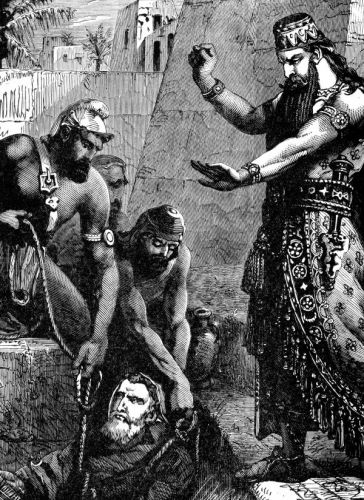
So Zedekiah handed Jeremiah over to his cronies and they threw Jeremiah down a well.


But Jeremiah’s preaching was not merely a political attack on the state; it was a call to individuals to decide to serve either the Kingdom of God or the Empire of Men. Jeremiah’s cry was a call to conversion, repentance and reliance upon God.

Jeremiah was addressing a critical issue of his day – one that we also face: the idea of building a society cut off from God, cut off from the influence of faith, and trusting only in ourselves, our wealth, our power.

Yet we each have our own private alliances with sin. We all make deals with evil. We try to bargain with the devil. We play games with our demons, our sinfulness. We succumb to temptation and rationalize our sins away. We often want the easy way out, but spiritual formation and discipleship takes practice and discipline.

For instance, it’s easier to watch TV or get on Facebook than pray, go to Mass, pray our rosary, or volunteer somewhere. We often don’t want to fight that inner battle of placing ourselves in the hands of God.  

How many things take the place of God in our lives each day?

And so many of us, myself included, often engage in half-hearted worship and a lack-luster faithfulness to God and neighbor.

Jeremiah challenged false worship and the social policy of his day; reliance upon the empire rather than upon God.

The message is the same today.

Yet to proclaim this truth will cause us pain. Division. A sword. 

The Cross.


Jesus certainly disturbed the phony peace of the Roman Empire and the status quo of the religious establishment of his day.

Jesus spoke truth to power. And he, like Jeremiah, was arrested for his prophetic voice in the face of power and religious intolerance. Both Jeremiah and Jesus illustrate for us the personal cost that a decision for God can bring about.

Being a disciple of the Lord is not easy. Yet in our faithfulness the Lord will be with us; and though we may lose some friends, we will gain others, brothers and sisters in the Lord.


In the divine mystery, we will suffer. But if we suffer in our faith, and persevere in running the race, keeping our eyes fixed on Jesus, we will not lose heart in our struggle against sin.

* But as Jesus’ prophetic peacemakers, we will likely stir up trouble advancing the kingdom of God.

Yet we are called to bring peace. But to the world it will not look like peace. It is a peace that the world cannot give – or receive.

The world offers us a false peace without justice. But without justice there can be no true peace. So as prophets we must continue to resist our culture of violence, a culture of death, and war.


But when we fulfill our role as prophet, and stand up for what is right, we may suffer martyrdom. [None of us here in the U.S. have to fear for our lives in attending Mass like some of our brothers and sisters in Egypt and other parts of the Middle East. We are not standing in a burnt out church this morning either].

Yet some of us may suffer a form of martyrdom by being ridiculed by our peers, even by our family members and fellow Catholics for our enthusiasm in taking Jesus at his word, whether it is in our defending the poor, taking a stand for justice, questioning American foreign policy or domestic policies, or even remaining true to our faith. 

We may be put to death socially. We may suffer a bloodless martyrdom of gossip. We may not be invited to any more of the social soirees.

We may be chastised for praying for or ministering to a man condemned for murder. We may be ridiculed for ministering to the marginalized and welcoming the immigrant [how dehumanizing is it to declare a human person an alien?] and embracing the unwanted, those considered less than human.

We may be judged by some believers because we continue to love a gay son or daughter, or continue to show compassion to the prodigals in our midst.

We may be ignored because we passed up a cocktail party to work the soup kitchen or attend a justice rally. We may be scorned because we choose mercy over judgment. 

Or we may be snubbed because of our defense of the unborn child, or our insistence that the death penalty ought to be abolished, or that war should be a last resort-if ever. 

The irony in this is that when we speak to these issues, and seek mercy and peace, we will likely be called disturbers of the peace.

And in our world, that’s enough to make you an enemy of the state.

And, sometimes, it’s enough to make you an outlaw in your own family.

May the grace of our baptismal call set us on fire as joyful prophets of the Lord!