A Motherly Love
Sixth Sunday of Easter
10 May 2015

Some of you may recall the tornado
that destroyed Henryville, Indiana. Stephanie Decker, a mother of two, was at
home when her husband texted her that a tornado was bearing down on their
neighbor-hood. Stephanie took her 8 year old son and 5 year old daughter and
huddled in the basement.
She covered them with a comforter and then shielded her children with her own body to prevent debris from landing on them when the twister hit the house. As the house disintegrated, wreckage broke seven of her ribs and two steel beams severed her legs. She couldn’t move. The storm continued to ravage her home until the tornado collapsed the house around her and her children. Her actions saved her children, but when she was taken to the hospital, both of her legs had to be amputated – one just below the knee, the other just above it.
There is no greater love than this, to lay down one's life for one's friends.
Today in America, we celebrate Mother’s Day. And May is the Month of the Blessed Mother Mary, for whom all Christians can call Mother.
But Mother’s Day can be a painful time too, especially for the childless and mothers who have lost a child by miscarriage or in childbirth, and those mothers who have grieved the death of one of their children, God comforts you, for He knows the depths of your loss and grief, and be assured of our prayer and love.
For most of us here we are thankful for our mothers, and other women and mothers in our lives: grandmothers, aunts, co-workers, or neighbors who have been mothers-figures, or adoptive mothers or step-mothers. And what of the women of faith and courage who inspire us, our “faith-mothers”, or any of the many religious sisters and faithful Christian women who have influenced us and loved us and served us for so long almost with no thanks. There is no greater love than this, to lay down one's life for one's friends.
One mother told me, “The love that a mother feels for her children can't be defined by words. Few mothers give their lives for their children by dying for them, but most mothers do daily die to themselves in order to give so much.” Another mother said: “A mother’s love is like that of God’s love, for we give our love willingly and abundantly without expecting anything in return… In fact we give in hope that our children will realize that love is unconditional.” There is no greater love.
Jesus reminds us that God loves us unconditionally just like mothers who love their children despite their faults. Mothers often say they never thought they could love another person as they love their child. And yet with each new child, they feel their love expand.
She covered them with a comforter and then shielded her children with her own body to prevent debris from landing on them when the twister hit the house. As the house disintegrated, wreckage broke seven of her ribs and two steel beams severed her legs. She couldn’t move. The storm continued to ravage her home until the tornado collapsed the house around her and her children. Her actions saved her children, but when she was taken to the hospital, both of her legs had to be amputated – one just below the knee, the other just above it.
There is no greater love than this, to lay down one's life for one's friends.
Today in America, we celebrate Mother’s Day. And May is the Month of the Blessed Mother Mary, for whom all Christians can call Mother.
But Mother’s Day can be a painful time too, especially for the childless and mothers who have lost a child by miscarriage or in childbirth, and those mothers who have grieved the death of one of their children, God comforts you, for He knows the depths of your loss and grief, and be assured of our prayer and love.
For most of us here we are thankful for our mothers, and other women and mothers in our lives: grandmothers, aunts, co-workers, or neighbors who have been mothers-figures, or adoptive mothers or step-mothers. And what of the women of faith and courage who inspire us, our “faith-mothers”, or any of the many religious sisters and faithful Christian women who have influenced us and loved us and served us for so long almost with no thanks. There is no greater love than this, to lay down one's life for one's friends.
One mother told me, “The love that a mother feels for her children can't be defined by words. Few mothers give their lives for their children by dying for them, but most mothers do daily die to themselves in order to give so much.” Another mother said: “A mother’s love is like that of God’s love, for we give our love willingly and abundantly without expecting anything in return… In fact we give in hope that our children will realize that love is unconditional.” There is no greater love.
Jesus reminds us that God loves us unconditionally just like mothers who love their children despite their faults. Mothers often say they never thought they could love another person as they love their child. And yet with each new child, they feel their love expand.
Yet nothing can compare with
the love of God; in fact it is almost impossible to comprehend. Yet this is the
love we called to participate in. Just as God sent his only Son into the
world so that we might have life through him, when a woman gives birth or
nurtures another person, she is giving new life to the world.
Jesus even compared his deep love for his people to that of mother bird; “As a mother hen longs to gather her chicks under her wings, so I long to gather you to myself” (Luke 13.34). Elsewhere He says, "The Kingdom of God is like a Woman in search of a lost coin" (Luke 15.8-9).
Jesus even compared his deep love for his people to that of mother bird; “As a mother hen longs to gather her chicks under her wings, so I long to gather you to myself” (Luke 13.34). Elsewhere He says, "The Kingdom of God is like a Woman in search of a lost coin" (Luke 15.8-9).
Jesus knows the depths of love and the pain that often
accompanies a mother’s love. There is no greater love than this than to lay down
one’s life for one’s friends.
And though we call God “Father”, we may take the mystery of God for granted, and forget that God cares tenderly for his children like a mother. The Scriptures reveal God’s tenderness and strength in images of motherhood.
“In the Psalms God is compared to a nursing mother, God forms men and women in the womb, God carries the Chosen People like a mother carrying her children in her womb, giving birth to them in the Land of Promise.”
And just as mothers carry their children in their womb and nourish them with their own body and blood, and after giving birth, the mother’s breast feed their children, St. Julian of Norwich wrote: “Jesus, [our beloved Mother] feeds us with himself…” (Julian of Norwich, 14th century).
There is no greater love than this.
And though we call God “Father”, we may take the mystery of God for granted, and forget that God cares tenderly for his children like a mother. The Scriptures reveal God’s tenderness and strength in images of motherhood.
“In the Psalms God is compared to a nursing mother, God forms men and women in the womb, God carries the Chosen People like a mother carrying her children in her womb, giving birth to them in the Land of Promise.”
And just as mothers carry their children in their womb and nourish them with their own body and blood, and after giving birth, the mother’s breast feed their children, St. Julian of Norwich wrote: “Jesus, [our beloved Mother] feeds us with himself…” (Julian of Norwich, 14th century).
There is no greater love than this.

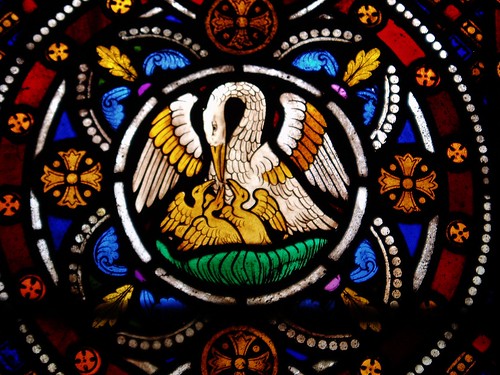
St. Thomas Aquinas employed the image of the pelican for Christ in his hymn Adoro
te. The Pelican was seen as a figure of Christ’s motherly love in the
Eucharist. Centuries ago, people believed that the mother pelican fed her
own flesh to her offspring. That is why on the top of some very elaborate altar
pieces, such as St. Boniface in Evansville or the Old Cathedral in Vincennes,
there is a pelican with a bleeding heart, feeding its offspring. Now, even
though science has shown that this is a myth, the image of the mother pelican
still reminds Catholics of Jesus feeding us with his Flesh and Blood in the
Eucharist so that we might have life. In the gift of the Holy Eucharist we
encounter the self-emptying and self-giving of Christ, like a loving mother.
There is no greater love than this.
The Catechism of the Catholic Church attest to the beauty of the this metaphor of God as Mother: God's parental tenderness can also be expressed by the image of motherhood. But we know that human parents can disfigure both the face of fatherhood and motherhood. We ought therefore to recall that God is GOD…[but] no one is father as God is Father (CCC 239).
God is love. And God gives love freely. It is a love that can completely transform us. For love is patient, love is kind, it believes, it hopes, it protects, it trusts, it perseveres and endures! God is love and God shows no partiality!
If we live in God, then God will live in us; and since God is love, then love will dwell within us. And we who are Christian and have been baptized INTO Christ, share in the divine nature, and because of that we can live out the divine love as God does and as Christ did and continues to do so.
Jesus said: "As the Father loves me, so I also love you. Remain in my love. If you keep my commandments, you will remain in my love. I have told you this so that my joy may be in you and your joy might be complete.” There is no greater love. [So may we rejoice in his love and joy this day and every day].
But Jesus doesn’t let us off easy. We are to share his love and mercy and joy with one another, no matter who they are or what they’ve done. Remember what He said: “This I command you: love one another." We pray for the grace and the strength to love one another as he has loved each of us.
There is no greater love than this.
There is no greater love than this.
The Catechism of the Catholic Church attest to the beauty of the this metaphor of God as Mother: God's parental tenderness can also be expressed by the image of motherhood. But we know that human parents can disfigure both the face of fatherhood and motherhood. We ought therefore to recall that God is GOD…[but] no one is father as God is Father (CCC 239).
God is love. And God gives love freely. It is a love that can completely transform us. For love is patient, love is kind, it believes, it hopes, it protects, it trusts, it perseveres and endures! God is love and God shows no partiality!
If we live in God, then God will live in us; and since God is love, then love will dwell within us. And we who are Christian and have been baptized INTO Christ, share in the divine nature, and because of that we can live out the divine love as God does and as Christ did and continues to do so.
Jesus said: "As the Father loves me, so I also love you. Remain in my love. If you keep my commandments, you will remain in my love. I have told you this so that my joy may be in you and your joy might be complete.” There is no greater love. [So may we rejoice in his love and joy this day and every day].
But Jesus doesn’t let us off easy. We are to share his love and mercy and joy with one another, no matter who they are or what they’ve done. Remember what He said: “This I command you: love one another." We pray for the grace and the strength to love one another as he has loved each of us.
There is no greater love than this.